“The wisdom, therefore, that reaches out beyond the sensible and reveals to him his own being and with it his final goal, may well be called divine wisdom or theosophy” (xxii).
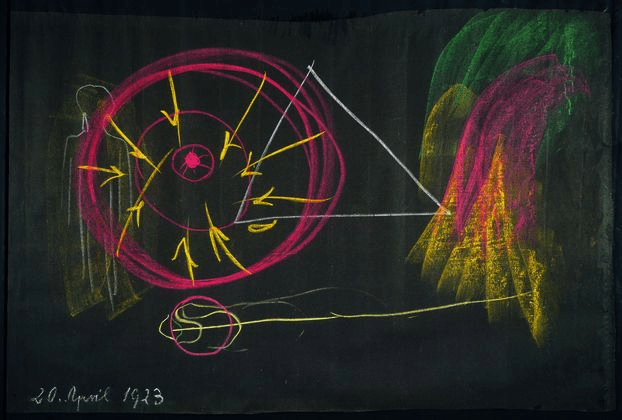
The opening of the “eye of the spirit”, the actualization of latent, in-dwelling supersensible faculties, begins with a feeling. He or she who is initiated in spiritual matters has gone beyond what was once a premonition, what was concealed behind the sensible given, to truly know the immortal aspect of man. This knowledge, however, could not have been cultivated without an initial openness of heart and spirit. One must first disabuse one’s self of the prejudice of scientism, which considers real only what is accessible to the ordinary senses. Doing so, one may attune their entire being to the manifest facts of higher realities.
In Theosophy, Rudolf Steiner articulates the following guiding principles for an Anthroposophical inquiry into such realities:
Spiritual egalitarianism: “Everyone, however, who has patience and endurance reaches this goal, for although not every physical eye can be operated on, every spiritual eye can be opened. When it can be opened is only a question of time” (xix).
Methodological anti-scientism: “Indeed, what is often called at the present time the only true science can, for the attainment of this goal, be frequently a hindrance rather than help because this science considers real only what is accessible to the ordinary senses” (xix).
In this spirit, we might say that modern natural science is ontologically prejudiced; it accepts as real only what is available to the sensory organs, and this it does a priori. This science has made tremendous strides in the domain of human knowledge precisely because of this self-limitation. Just because science has contributed immensely to this domain and, from the outset, has circumscribed its range of study to the sensible, does not mean we cannot seriously study higher dimensions or fields of reality. These fields demand their own respective methods and attitudes which natural science can have no role in determining.
While engaging in spiritual science, we must bear in mind that these distinct modes of knowing are in no sense incompatible, even if incommensurable: “Because in truth all reality, the lower as well as the higher spiritual, are only two sides of one and the same fundamental being, anyone who is ignorant in the lower branches of knowledge will as a rule remain ignorant in the higher” (xxi). The intelligibility and import of Anthroposophical findings presuppose only the seeker’s unconditional allegiance to truth.
The Threefold Division of Man
Steiner, speaking through Goethe, posits a threefold model of man’s relatedness to the world on the basis of a tripartite division of things-in-man’s-world. Such things include:
- “The objects concerning which information continually flows to him through the doors of his senses- the objects, he touches, smells, tastes, hears, and sees” (2).
- “The impressions [sensible objects] make on him, characterizing themselves through the fact that he finds one sympathetic, the other abhorrent, the one useful, another harmful” (2).
- “The knowledge that he, as a ‘so to speak divine being’, acquires concerning the objects, that is, the secrets of their activities and their being as they unveil themselves to him” (2).
The first class of objects encompasses the sensible ephemera that comprise a “world” for us. On the basis of information about these objects we take in through the senses, we accord their fleeting impressions inner permanence by, on the one hand, preserving the memory of how they affect us, and on the other hand, acquiring eternal knowledge of the objects’ inner and outer workings. Here, we are not in the realm of utilitarian or pragmatic knowing, but are instead guided by a teleological Good implicit in the pursuit of knowledge, free of egoistic concern; we simply let things speak for themselves and wholeheartedly encounter them in this expression.
From this division of inner and outer entities, Anthroposophy deduces a threefold model of the human being, consisting of body, soul, and spirit:
- “By body is here meant that through which the things in the environment of a man reveal themselves to him” (4).
- “By the word soul is signified that by which he links things to his own being” (4).
- “By spirit is meant what becomes manifest in him when, as Goethe expressed it, he looks at things as a so to speak divine being” (4).
Knowledge, whose proper territory is the transcendental spirit, illuminates the immortal kernel of humanity, for it allows one to momentarily shed the skin of corporeality and immediacy to assume a viewpoint from heaven.
“For example, man looks up at the starry heavens. The delight his soul experiences belongs to him. The eternal laws of the stars that he comprehends in thought, in spirit, belong not to him but to the stars themselves” (5).
Humans are related to mineral, plant, and animal forms of bodily existence insofar as each of these forms participates in them. Like minerals, our bodies are composed of natural elements. Like animals, we grow, reproduce, and establish a perceptual connection to things outside of us, retaining their presence through inner impressions. Yet, our nature is of such sophistication and spiritual refinement that we cannot model it on plant and animal life alone.
Although the body constrains the soul’s horizons, soul activity cannot be straightforwardly reduced to bodily functions. We are not slaves to our bodily excitations from without; we are capable of stepping back from experience and subjecting it to examination. As we objectify and dwell on our sensations and perceptions, we acquire knowledge of the laws and forces underlying them.
Our spiritual dimension is as different from our soul dimension as the soul is from the body: “As long as only the particles of carbon, hydrogen, nitrogen, and oxygen that are in motion in the body are spoken of, we do not have the soul in view. Soul life begins only when within the motion of these particles the feeling arises, ‘I taste sweetness,’ or ‘I feel pleasure.’ Likewise, we do not have the spirit in view as long as merely those soul experiences are considered that course through anyone who gives himself over to his bodily life” (9).
 Origami Cosmos
Leave a comment